
How you hold an ukulele is one of the most fundamental skills a uke player needs to have. A surprising number of people miss this lesson and do it wrong.
When you hold the uke incorrectly you make it harder to hang onto and it’s more difficult to move from chord to chord or note to note. It’s not hard to get right though. So read on and I’ll show you everything you should know.
This is a good general view of how you should hold your uke. Notice how everything flows naturally and there aren’t any awkward joint angles.

Learn all about this subject and more in…

Play easier, faster, and more confidently by improving your ʻukulele technique. This nine hour video course will take your picking from struggle to exceptional.
How to Hold Your Strumming Arm/Hand:
Hold the ukulele against your chest with your right forearm across the top or side edge of the lower bout. Where exactly your arm crosses over depends on the size of your ukulele.
- For a soprano, place your arm over the far-right edge of the uke
- For a tenor, place your arm higher up on the corner
Your strumming finger should be able to comfortably reach almost to where the neck meets the body. Depending on if you’re picking or strumming, you’ll want to change how far your forearm reaches over.
The below photo shows the best place to strum. If you try and strum the strings closer to the bridge, it gets harder to move the strings and the sound is more banjo-like.

For picking, you get a more articulate tone by moving a bit closer to the bridge. See below:

These zones are just guidelines for a good ergonomic start. You can strike the strings anywhere on the instrument to get different tones and timbres. Check out my article on how to change your tone here.
Fretting Arm/Hand:
Your left hand helps support the neck of the ukulele, but it also needs to retain some mobility to move between chords. In order to do this you can rest the neck on the base of your index finger for some chords. Usually when this isn’t a viable option, the downwards pressure of fretting will keep the uke in place.
Your fretting fingers should be close to parallel with the frets for most chords.
Put the pad of your thumb on the top half of the back of the neck behind your first couple fingers. This allows you the most range of motion. For more difficult chords you can move the thumb out to the left to get a little more leverage.
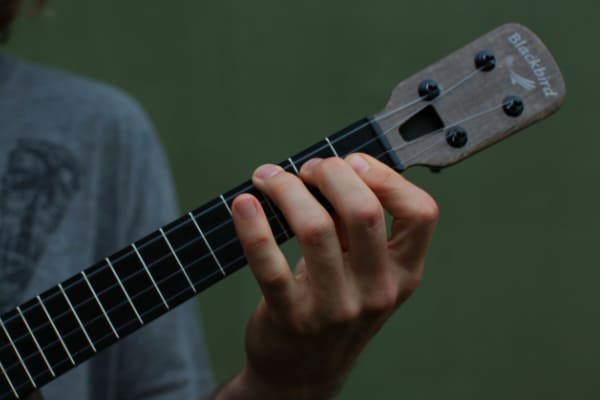
Your wrist should stay in line with your arm with a gentle curve upwards to reach the frets. Don’t bend it excessively unless you need to twist sideways a bit to reach a chord like G7.
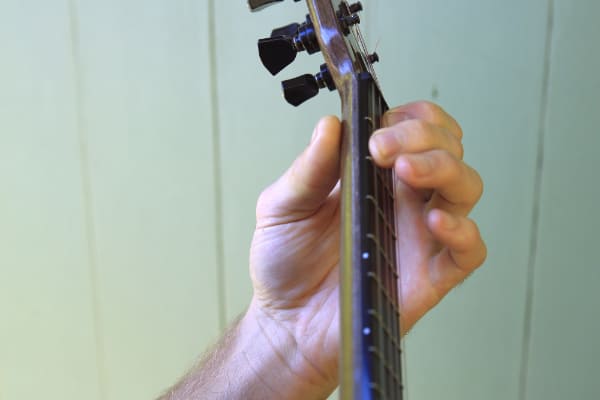
It helps a lot if you trim your fingernails short on your left hand. Otherwise your nails will be holding the pad of your finger off the fretboard. This works against your efforts at fretting and makes it necessary to compromise your hand position. Just cut your nails.
Keep your elbow a couple inches away from your side as you hold the ukulele. You want all your joints from your shoulder to your fingers to be in line as you look down at your arm.
How to Hold an Ukulele in a Nutshell:
You should:
- Hold an ukulele in a relaxed manner.
- Keep your thumb behind the neck.
- Keep the ukulele upright and against your chest/belly.
- Keep your fingers relatively parallel to the frets – unless you are playing a chord that requires you to turn your wrist.
But don’t:
- Let the ukulele slide flat onto your lap. This makes things much, much harder for your wrist.
- Squeeze the ukulele to death. Find the happy medium that supports the instrument but also lets you relax.
- Hold your elbow way out.
- Hold your elbow tucked all the way in or in front of you.
James Hill has some great tips in this video about how he supports the uke:
To make sure you’ve got it – and to make sure you keep the feel in your body – you should actually apply this knowledge in one of the easy ukulele songs you can find here. Everything you learn needs to be applied in real music. Otherwise it won’t have any relevancy to your ukulele playing.
Left or Right Handed?
Since most people are right handed, most play the ukulele using their right hand to strum and their left hand to fret. But what if you’re left-handed?
There’s no right answer. Some lefties (like me) learn to play right handed. Some flip their ukulele around the opposite way.
If you’re not sure what way to play, try just holding the uke – first with the left hand on the fretboard, then with the right hand on the fretboard. See if one is obviously more comfortable.
Should the uke feel more comfortable with your left hand on the fretboard, just continue on your way and learn to play right handed. There’s nothing wrong with this and will probably make learning ukulele easier since most instructional material is for right-handed uke.
Should the uke feel more comfortable with your right hand on the fretboard, you’re a true lefty! There are a couple of different ways you can string up a uke to accommodate your Southpaw-ness:
- Play the ukulele how it is, just turn it upside down (A-string closest to your face). This turns all learning material 180 degrees
- Take the strings off and put them on backwards (G-string closest to your face). This mirrors a right handed ukulele on the horizontal plane
You will have to decide what configuration is right for you, but the former is going to give you the ability to pick up any ukulele and play it. This in itself is a huge reason to learn “upside down.” You don’t want to be stuck needing a specially tuned instrument to play. But the ukulele is strung the way it is for a reason and it’s nice to have the lower notes higher up on the fretboard.
If neither orientation really spoke to you and you couldn’t tell the difference, I would recommend trying to hold the ukulele right handed. This has the benefit of an easy start. You don’t have to convert chord diagrams in your head or switch your ukulele around.
More Tips:
How to make your strumming hand as graceful as possible.
A strap does most of the holding for you! They can be especially useful when standing up.