
Plugging in electronically amplifies your ukulele. This makes it louder than life and is how professionals play shows and get their music heard by a big audience.
This requires additional gear. While it might be tempting to buy fancy stuff, it’s advisable to use the cheapest equipment you can find or borrow to see if amplification is something that you want to pursue. It’s only relevant to certain ukulele players.
What You Need
If you want to plug in your ukulele for the first time, you need a few things:
- A pickup in your ukulele
- A 1/4″ instrument cable
- An amp
Pickup
Whatever pickup your ukulele has is fine to get started. It might not have the best sound, but the price is right. Just make sure it has a fresh battery, if applicable.
The cost of getting an aftermarket pickup installed is often more than a whole new, low-end ukulele that comes with a pickup. Unless you need your high-end ukulele upgraded to be stage ready, go for the cheap uke with a pre-installed pickup so you can experiment freely!
Add-on, external pickups like stick-on or tied-under-the-strings options can work, but often create a ton of needless problems. I would go for a real pickup whenever possible.
Amp
 The best amp for getting a natural ukulele tone is an “acoustic amp.” These are made to be plugged directly into with any piezo-electric, acoustic pickup, which is the standard for ukes. Fishman, Fender, Blackstar, Acoustic brands are all fine.
If you only want to make noise with effects – at the expense of tonal quality – an electric guitar amp is often a better pick. These amps have built in distortion, echo, and modulation, but usually sound tinny and thin with a uke.
In my opinion, an acoustic style amp is a more flexible foundation, whereas an electric style amp is a one-trick-pony. Here are some decent amp options.
Cable
You need a 1/4″ phono instrument cable to connect your uke to the amp. This is sometimes called a “guitar cord.” Any one will work as long as it has a tip contact and a sleeve contact divided by a single isolator line.
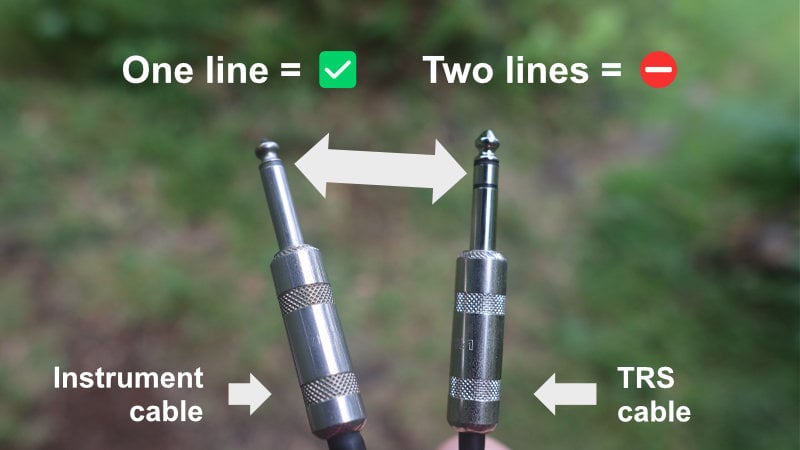
The TRS cable on the right can work, but the extra “ring” contact can also cause unexpected problems that a newbie will struggle to troubleshoot.
Get an instrument cable that’s 10′ or 15′ long.
A cheap cable is fine to start with, but if you think you’re going to plug in often for a long time, a nice, high quality cable is likely a smart, long-term investment. (I use Mogami Gold cables and have never had one die in hundreds and hundreds of gigs.)
How To Plug In
Before turning your amp on, make sure that all volume knobs are at zero. Otherwise you might start your session with feedback or loud pops!
Plug one end of the instrument cable into the jack on the bottom of your ukulele until it “clicks” into place as far in as it will go.
Plug the other end of the cable into the “input” jack on your amp in the same fashion.
If your ukulele pickup has a volume control, set it to 3/4 of the way up to start.
Slowly turn up the volume on the amp as you strum the strings until you reach the desired volume level.
Think of it like this: the input gain lets volume into the amp, the master gain lets it out of the amp. In general, you want the gain to be set lower than the master volume.
Once you’re up to volume, you’re ready to jam! Any adjustments from this point on are just optimizations through experimentation.
EQ
Most pickups don’t sound their best when set “flat.” It helps to tweak their frequency response to get the ideal tone. This is done with equalization controls.
On an amp with a single “tone” control, turning the knob:
- Clockwise will increase the high end and reduce the low end
- Anti-clockwise will increase the low end and reduce the high end
Try turning the tone knob clockwise a bit until the woofy low end goes away.
On amps with two EQ knobs, “bass” and “treble,” each controls their respective frequency range (clockwise increases the frequency gain, anti-clockwise decreases the gain).
Try turning the treble up a bit and the bass up slightly, if the tone isn’t too boomy. This creates the perception that the mids are reduced, which is often desirable for ukulele pickups.
Avoiding Feedback
Feedback is the nasty screeching sound that happens when a mic gets too close to a speaker. This is from the speaker directly vibrating the mic diaphragm, which then sends the signal back through the speaker again, creating a feedback loop.
Ukuleles can also suffer from feedback when the speaker resonates the soundboard. This happens at a slower pace so the pitch of the feedback is lower – a hum instead of a squeal.
Eliminating feedback starts with the position of your gear. Placing your ukulele or mic directly in front of a speaker is a recipe for feedback.
Instead, move your ukulele out of the direct line of fire from your amp. Even at high volumes (which increase the chances of feedback), there’s usually a place you can position yourself to find a null in the wavelength that causes the feedback.
If you can’t move out of the way, try adjusting your EQ to minimize the frequency that is feeding back. This is best done with a notch filter or parametric EQ band, which can be obtained by using a preamp.
More about preamps for ukulele
Upgrade Path
Many people spend their money on the wrong gear to get a certain amp outcome.
Assuming I had a decent acoustic amp as my foundation, if I wanted to get the highest quality tone from a bedroom amp setup, I would prioritize these purchases:
- Preamp – having fine control over the EQ will make the biggest difference in the tone you can get
- My Plug In ebook – I have included everything I know, as a performing ukulele artist, about getting the most out of your gear in this detailed, 90 page guide
- Pickup upgrade – you can buy all the fancy gear in the world, but if your pickup sucks, it will never sound very good. A nice, UST-style pickup like an LR Baggs Five-O or Fishman Matrix that is installed well will give you a better starting point than most pre-installed uke pickups
Video Guide:
All the information here and more has been expanded and reworked into a complete guide on plugging in your ukulele! Learn to make all the connections and adjust the settings for optimal tone:

Optimize your gear and settings to get a killer amplified ukulele tone and learn the key elements of live sound.