
Strumming an ukulele is easy do, but hard to master. This lesson will walk you through the fundamentals that make your rhythm sound smooth and confident.
Hand Position
The index finger is the best method for strumming. It provides the most ergonomic motion and a platform for more advanced techniques as you improve.
Form an “L” with your strumming hand and “let the air out of it” so that your index finger curls in to a loose 90 degree angle to the rest of your hand. This is the default ukulele strumming position.
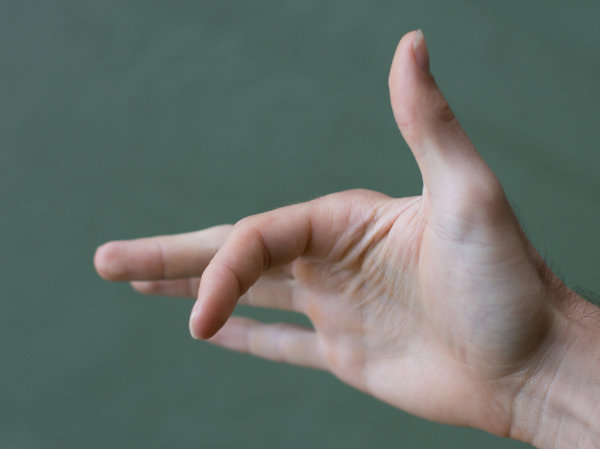
Your other fingers can be fanned out for counterbalance.

…Or held in a loose fist.
Avoid bracing it firmly with your thumb. It’s okay if they touch, like in the above photo, but don’t squeeze them together!
Downstrum
Brush across all the strings in a downwards motion with your index finger. Keep your finger floppy and slightly curled and droop your wrist a bit so the back of your fingernail hits the strings.

Strum close to where the neck meets the body of the ukulele. This gives you the best tone and least amount of string resistance.
As you strum, your wrist twists downwards towards the floor and your forearm drops. Imagine the motion is a blend of opening a doorknob and hammering a nail.
- Hold your finger stiff, braced, or straight
- Hit the strings with the side of your finger
Downstrums are usually played on the beat counts (1…2…3…4…).
Upstrum
If you play steady downstrums on the beat, you’ll notice that in order to return to the top of the downstrum, your hand has to move upwards. Simply hit the strings on the way up to add eighth notes on the “and”s of the count. “1 and 2 and 3 and 4 and!”
Continue to keep your finger floppy! When you strum upwards, you’ll hit the strings with the pad of your index finger. If the strings pull your finger straight, that’s fine, it allows your finger to pass smoothly over them without hooking.
Down & Up Together
In between each strum you’ll have a zero point where your wrist and arm reverse directions. Try to make this as smooth as possible. Don’t snap back and forth.
- As you strum faster, move less by using more wrist motion and less forearm hammering
- As you strum slower, move more by using more forearm hammering and less wrist motion
Thumb Strum
For reasons that are beyond me, many people naturally gravitate towards strumming everything with their thumb.
This is fine. There’s not really anything “wrong” about it and some songs can benefit from the mellow sound of a simple thumb downstroke.
However, I tend to encourage people away from this way of strumming simply because it’s not a very expandable motion – the way the thumb hits the strings limits your options for chunking, and different tones.
Like most things on ukulele, you’ve got to be patient with your strumming progress and not go racing ahead.
Spend a couple weeks just strumming down/up until it’s very natural. Learn a couple simple songs and focus on getting the strumming as smooth as possible.
As you “chalangalang” (a fancy name for a swinging down/up strum), you’ll be developing muscle memory that will be vitally useful for other strum patterns.
Chunk Strum
The chunk – or chop – strum is a popular decoration to any contemporary strumming pattern. I made a separate lesson page for it:
I’ve compiled all my best strumming knowledge into an ebook with video lessons. If you really want to learn the mechanics of strumming and a simple system that will allow you to follow the rhythm of almost any song, it’s all I can recommend:

A system for strumming more rhythmically and intuitively. Stop playing strumming patterns and start playing songs!
Swing & Straight Feels
When you strum down and up you are creating a rhythm. If you examine the rhythm you’ll see that all the downstrums happen on the count: 1…2…3…4… If you only play downstrums you’re basically counting the song in quarter notes.
Upstrums happen between the counts. They can also be “counted” by naming the upstrums “and” (often notated with “+”).
In this way you can count: (1) and (2) and (3) and (4) and to play only the upstrums.
Combine both down and up motions and you get the whole shebang: 1 + 2 + 3 + 4 +. Now we’ve divided four counts into eighth notes.
Any time you play eighth notes they can have a “feel.” This falls into one of two categories: swing (also “shuffle”) or straight.
Straight is the most simple to visualize: it’s completely even between two eighth notes. Both “sides” are the same duration – like the ticking of a clock or the swing of a pendulum.
Swing, on the other hand, makes the notes lopsided. Loooong, short, looong, short. This gives the strum a galloping feel.
Funny thing is, gravity works in favor of a swing strum which is why most people naturally play ukulele strumming patterns with this feel. Your hand drops easily with gravity, but then you pull it up with effort and then let it fall again as soon as possible so you don’t have to waste any energy. This naturally creates a long, short swing feel.
Here’s a video explanation and demonstration of the two feel styles:
Learn to play both as most songs sound better with one or the other.
Strumming Tips Video Lesson
Here’s a tutorial on some quick tricks to help improve your strumming.
Common Ukulele Strumming Patterns
Once you’ve spent sufficient time practicing the basic strum, you can expand upon it by learning some different strumming patterns. These follow the same general down/up motions, just in different orders and timings.
D=down, U=up, (space)=rest, X=chop.
There are only a few core strumming patterns before you break into more complex techniques and ideas, but these here will keep your hand/mind coordination busy!
D DU UD
This one is used in a lot of contemporary Hawaiian songs and is most people’s default “island” sounding strum.
The hand motion is down, down, up, up, down.
Since there are double downs and double ups, you must sometimes move in the opposite direction without strumming to get back to your starting point. This essentially makes the hand motion for this strum just a simple D/U pattern. The only difference is that you are only strumming the strings some of the time. The rest of the time you are skipping strums even though your hand is still moving.
This is key: Keep your hand moving the entire way through the strum pattern!
Here’s the timing:
1 + 2 + 3 + 4 +
D - D U - U D -
With the “invisible strums” and keeping your hand moving the entire time:
1 + 2 + 3 + 4 +
D(U)D U(D)U D(U)
U U U U – Reggae Strum
Also known as a “skank,” this reggae strum is incredibly simple to comprehend. Playing it however, is quite a trick in itself at first. The key lies in the amount of time you let your chords ring.
It’s a complex enough subject that I’ve created an entire three piece video series and a detailed lesson page to cover everything you need to know about reggae ukulele:
How to Play a Reggae Ukulele Strum
The “Somewhere Over The Rainbow” Strumming Pattern
Of all the ukulele strums people want to learn, it seems the one Isreal Kamakawiwo’ole used on Somewhere Over the Rainbow/Wonderful World is on the top of the list.
It’s not hard, but combines both picking and strumming to create a more hybrid pattern. This is a great example of how effective a simple ukulele style can be.
To play the Somewhere Over The Rainbow strumming pattern you need to loosen up and encourage a little bounce in your hand. The motions are:
- Pick the top (G) string with your thumb. This is where the bounce comes in. You have to move your hand up as you pick so you can be ready to play the next downstrum.
- Then strum down, up – down, up. There’s a hesitation between the down, ups.
Pick, down, up, down, up.
Don’t make it more complicated than it needs to be! As long as you get the bounce in your pick, you’ll be fine.
The chords for the intro are: C Em Am F. Apply the above strum to them and you should be well on your way. IZ plays with a low-G string on his ukulele so if your “pick” sounds too high, that might be the reason.
Here it is in tab:

Other Strum Pattern Resources
Since I keep a simple approach to strumming I’ll let others create huge libraries of strum patterns and just link to their great work.
Al Wood over at Uke Hunt has put together some great audio examples of his top uke strumming patterns.
Ukulele Go has an even larger selection with 32 patterns and a video demoing each one.
As long as you can count, you can figure these out. But please remember that at the end of the day, knowing 100 strumming patterns doesn’t mean jack if you can’t apply them well in a musical way. So pick a few favorite strums and learn to use them well in your favorite songs.
The Secret to Groovy Strumming
I’ve spent a lot of years as a teacher beating my head against a wall and wondering how to present strumming to students. They always want more, more, more strums and I want to teach less, less, less strums.
Why?
Because they (with a small handful of exceptions over the years) loose the rhythm as soon as they start to think about the new strum. If you lose the rhythm to gain a strum, what’s the point?
This is very frustrating for me as it often doesn’t improve very much with a lesson (or several) worth of practice. When this happens I don’t feel like I’ve helped them play better music. I’ve simply given them a distraction.
Fortunately, over years of thinking about this, I’ve made a few useful connections in my mind.
It starts with asking:
Why do beginners loose the groove when learning strums?
Because they go almost instantly from thinking about the music to thinking about the motion.
Problem is, they don’t KNOW the motion. And often just resort to guessing as best they can.
This manifests as robotic rhythm and unnatural hand movements. Which sometimes work, but mostly don’t.
The solution?
A Steady Eighth Note Motion
Eighth notes are counted like this:
1 + 2 + 3 + 4 +
If you strum with those counts you get:
D U D U D U D U
Now I’m going to make a bold statement:
There is no reason your hand shouldn’t make this motion AT ALL TIMES when you’re strumming, no matter the pattern.
There are two qualifiers for this statement:
- You’re a beginner/intermediate
- The strum is an eighth note strum
You wonder:
“Brad, how does your hand strum down, up if the pattern does something besides that?”
Because that’s the motion. Remember how I said people get lost when they start thinking about the motion?
Don’t change it.
What IS different is that for any eighth note strum besides down, up, you will skip playing on certain beats. You won’t skip the motion, but instead avoid sounding the notes as you go by.
Grab your ukulele. Make a strumming motion on it without hitting the strings and making noise. This is done simply by moving your hand out and away from you ever so slightly.
Easy, right?
Now try this strum:
1 + 2 + 3 + 4 +
D   D   D   D
Notice what you are doing on the “+” of each beat.
Unless you have two hands on your right arm (you’d be the envy of the uke world), you’re ghost strumming up on the “+” without sounding the strings.
So while the strum sounds like this:
1 + 2 + 3 + 4 +
D   D   D   D
It LOOKS like this:
1 + 2 + 3 + 4 +
D U D U D U D U
Now let’s try the classic DDUUD strum. It often trips people up the first time they try it. The ones who get it easily are the ones who retain the steady eighth motion.
It sounds like this:
1 + 2 + 3 + 4 +
D   D U   U D
But if you watch a player who’s comfortable with the strum it LOOKS like this:
1 + 2 + 3 + 4 +
D U D U D U D U
I invite you to check out Ukulele Go’s page on 32 strumming patterns if you haven’t already. They are all eighth note strums which is perfect practice for this.
Play through each one. And instead of thinking of a new motion, simply keep steady eighths going the whole time and change which strums you skip.
For instance, #24 sounds like this:
1 + 2 + 3 + 4 +
  U D   D   D
But play it like this (strums in bold and underlined):
1 + 2 + 3 + 4 +
D U D U D U D U
How to Figure Out Strums
99% of songs can be broken down into even eighth note chunks. That means, while perhaps not very musical, an eighth note strum should fit most songs.
Some will be straight eighths, some will be swing eighths. Doesn’t matter.
Listen to the song and play along with your eighth strum motion (if you don’t know the chords, mute the strings). It probably won’t sound very good.
If you have trouble finding the beat, read up on timing.
As you play, listen for the strong beats of the song – places with more emphasis than others. This is likely a place to keep a strum.
Try to decide on a scale of one to five the importance of each count and its eighth note. If you want to write it out – go ahead. This will become an instant assessment in the future, but sometimes it helps to do things the long way first.
Get rid of as many low-number strums as you feel is appropriate. This creates syncopation and sway and will sound a million times better than plain eighths.
There are always many variations possible on any song. The more comfortable with this idea you get, the more you will find.
A system for strumming more rhythmically and intuitively. Stop playing strumming patterns and start playing songs!